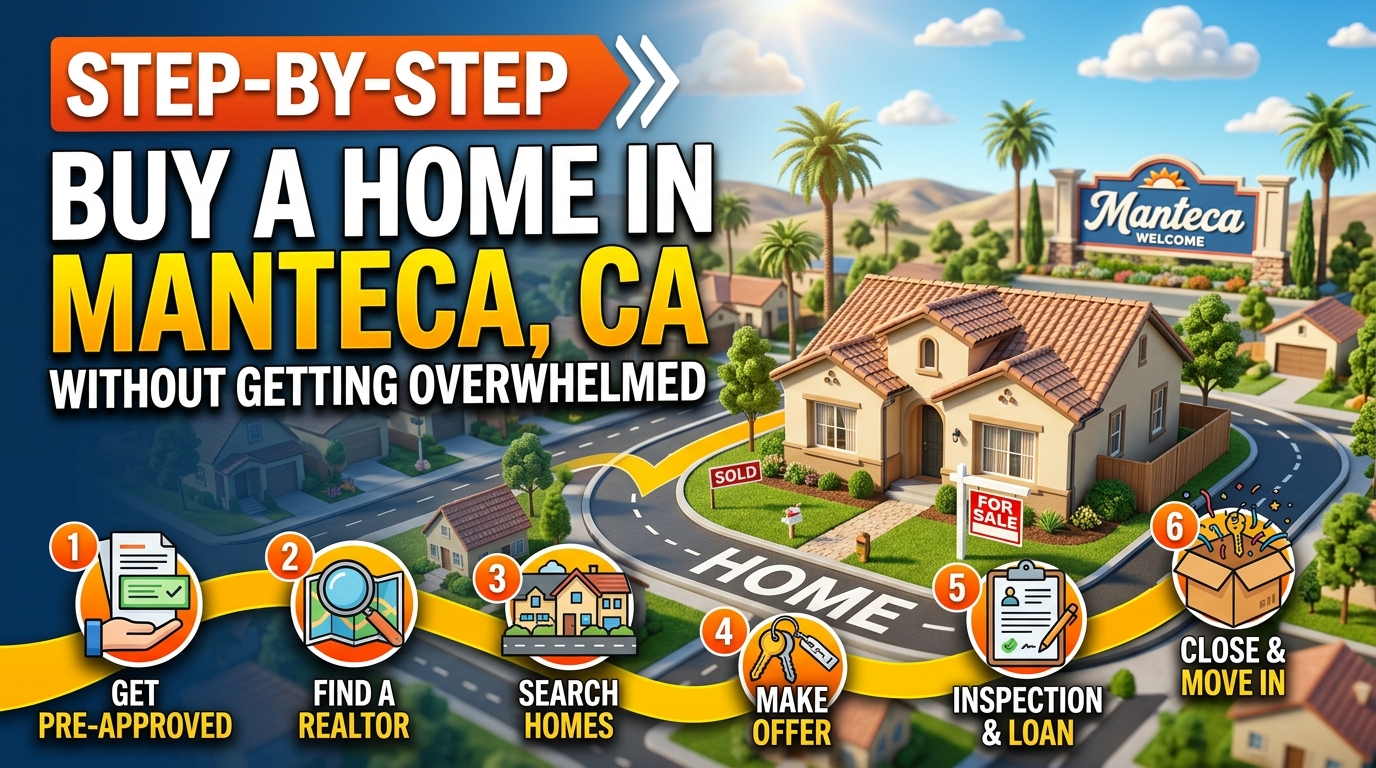
Step-by-Step: How to Buy a Home in Manteca, CA Without Getting Overwhelmed
Step-by-Step: How to Buy a Home in Manteca, CA Without Getting Overwhelmed
1. Decide Why You Want to Buy in Manteca1
2. Determine How Much Home You Can Afford2
3. Understand the Local Home-Buying Costs3
4. Get Pre-Approved for a Mortgage4
6. Create a Home-Buying Wish List6
10. Complete the Home Inspection10
12. Review the Final Details Carefully12
How to Keep the Process From Becoming Overwhelming14
Buying a home is exciting, but the process can also feel complicated—especially if you are purchasing your first property. From figuring out your budget to finding the right neighborhood, securing financing, making an offer, and completing the paperwork, there are many moving parts.
If you are considering buying a home in Manteca, California, the good news is that you do not have to tackle everything at once. Breaking the process into manageable steps can make the experience much easier and less stressful.
Here is a straightforward guide to help you understand what to expect
1. Decide Why You Want to Buy in Manteca
Before looking at listings, think about why Manteca is the right place for you.
Are you looking for more space for your family? Do you want to build equity instead of renting? Are you moving closer to work, family, or other amenities? Understanding your priorities will help you make better decisions throughout the buying process.
It can also help to research the local community, schools, neighborhoods, commute options, and amenities before committing to a purchase. If you're still deciding whether the city fits your lifestyle, read Is Manteca, CA a Good Place to Live in 2026? for a broader look at what living in Manteca may be like.
2. Determine How Much Home You Can Afford
One of the biggest mistakes buyers make is focusing only on the listing price.
Your actual housing budget should account for your mortgage payment, property taxes, homeowners insurance, potential HOA fees, utilities, maintenance, and other ongoing expenses. You will also need to consider upfront costs such as your down payment and closing costs.
A lender can help you understand how much you may qualify to borrow, but remember that the amount you qualify for is not necessarily the amount you should spend.
A comfortable monthly payment is more important than simply buying the most expensive home you can technically afford.
3. Understand the Local Home-Buying Costs
Before you start seriously shopping, get familiar with the costs associated with buying a home in Manteca.
These may include the down payment, closing costs, inspection fees, appraisal fees, lender fees, insurance, property taxes, and moving expenses. The exact amount you need will depend on the property, loan program, and your financial situation.
For a more detailed breakdown, read How Much Does It Cost to Buy a Home in Manteca, CA in 2026? This can help you create a realistic savings goal before you begin making offers.
4. Get Pre-Approved for a Mortgage
Once you have a general idea of your budget, consider getting pre-approved for a mortgage.
A pre-approval gives you a clearer picture of what a lender may be willing to finance. It can also make your offer more attractive to sellers because it shows that you have taken steps toward securing financing.
Compare lenders rather than automatically choosing the first option you find. Look at interest rates, loan terms, fees, estimated monthly payments, and the type of loan that best suits your situation.
5. Find a Real Estate Agent
A knowledgeable local real estate agent can make the home-buying process significantly easier.
Look for someone who understands Manteca's neighborhoods and housing market and who communicates clearly. Your agent can help you identify properties, arrange showings, evaluate comparable sales, negotiate an offer, and navigate the transaction.
Do not be afraid to ask potential agents about their experience, communication style, and approach to helping buyers.
6. Create a Home-Buying Wish List
House hunting becomes overwhelming when you try to find a property that checks every possible box.
Instead, divide your preferences into three categories:
Must-haves: Features you absolutely need.
Nice-to-haves: Features you would prefer but can live without.
Deal-breakers: Issues that would make you walk away.
Your list might include the number of bedrooms, yard size, garage, location, school considerations, home condition, and commute time.
Having clear priorities will make it easier to compare homes objectively.
7. Start Touring Homes
Now comes the fun part: seeing properties in person.
Try not to judge a home solely by its staging or décor. Pay attention to the layout, natural light, storage, condition of major systems, lot size, noise levels, and the surrounding neighborhood.
Take notes and photos when appropriate so you can remember what you liked and disliked about each property.
Most importantly, avoid feeling pressured to buy the first house you love. If a property does not meet your essential requirements or does not fit your budget, it may be better to keep looking.
8. Research the Neighborhood
The house itself is only part of your purchase.
Before making an offer, spend some time exploring the surrounding area. Consider traffic, nearby shopping and services, parks, schools, commute times, and the general feel of the neighborhood.
If possible, visit at different times of day. A neighborhood can feel very different on a quiet weekend afternoon than it does during a weekday commute.
9. Make a Smart Offer
When you find the right property, your agent can help you determine an appropriate offer based on factors such as recent comparable sales, the home's condition, market conditions, and the seller's circumstances.
Avoid making an emotional offer simply because you are afraid someone else will buy the property.
Your offer should fit your financial plan and reflect the property's value. Depending on the transaction, your offer may also include contingencies that protect you during the purchase process.
10. Complete the Home Inspection
An inspection can reveal problems that are not obvious during a showing.
Depending on the property, an inspector may identify issues involving the roof, foundation, electrical systems, plumbing, HVAC, appliances, or other components.
An inspection does not necessarily mean you should walk away if problems are discovered. Instead, it gives you information that can help you decide how to proceed and, where applicable, negotiate repairs or other terms.
11. Finalize Your Mortgage
Once your offer is accepted, your lender will continue working through the loan process.
You may need to provide updated financial documents, employment information, bank statements, and other paperwork. Responding quickly to requests can help keep the transaction moving.
Avoid making major financial changes during this period, such as taking on significant new debt or making large unexplained purchases, without discussing them with your lender.
12. Review the Final Details Carefully
As you approach closing, review the documents and costs carefully.
Confirm that the purchase price, loan terms, credits, fees, and other important details are accurate. If something does not make sense, ask your real estate professional, lender, or other appropriate professional for clarification before signing.
Buying a home involves significant financial commitments, so taking the time to understand the paperwork is worthwhile.
13. Close and Get the Keys
Once the required paperwork and financial steps are completed, you can officially close on your home.
After closing, you can collect your keys and begin moving in. Keep copies of your closing documents and important property records in a secure location.
It may take a little time to settle into the new home, so focus on the essentials first. You do not need to complete every renovation or furnishing project immediately.
How to Keep the Process From Becoming Overwhelming
The home-buying process becomes much easier when you focus on one stage at a time.
Instead of worrying about finding the perfect house, financing, inspections, negotiations, and closing all at once, work through the process in order:
Budget → Pre-approval → Agent → Home search → Offer → Inspection → Financing → Closing
Keep your financial limits in mind throughout the process, ask questions when you are unsure, and avoid rushing into a decision simply because the market feels competitive.
Final Thoughts
Buying a home in Manteca, CA does not have to be overwhelming. With a realistic budget, proper financing, clear priorities, and the right professionals helping you along the way, you can approach the process with much more confidence.
The key is preparation. Understand your costs, know what you need in a home, research the neighborhoods you're considering, and take each step one at a time. The goal is not simply to buy a house—it is to find a home that fits your lifestyle and financial situation for years to come.